
Introduction
Wondering what date it will be 90 days from today? This is a common question when planning deadlines, trips, study schedules, projects, subscriptions, appointments, or personal goals. Counting 90 days manually can be surprisingly easy to get wrong, especially when several months are involved.
The good news is that finding 90 days from today is simple when you understand how date counting works. A date calculator can also do the calculation instantly and help avoid mistakes.
What Is 90 Days From Today?
“90 days from today” means finding the calendar date that occurs exactly 90 days after the current date. The calculation moves forward one day at a time, while taking into account the different lengths of each month.
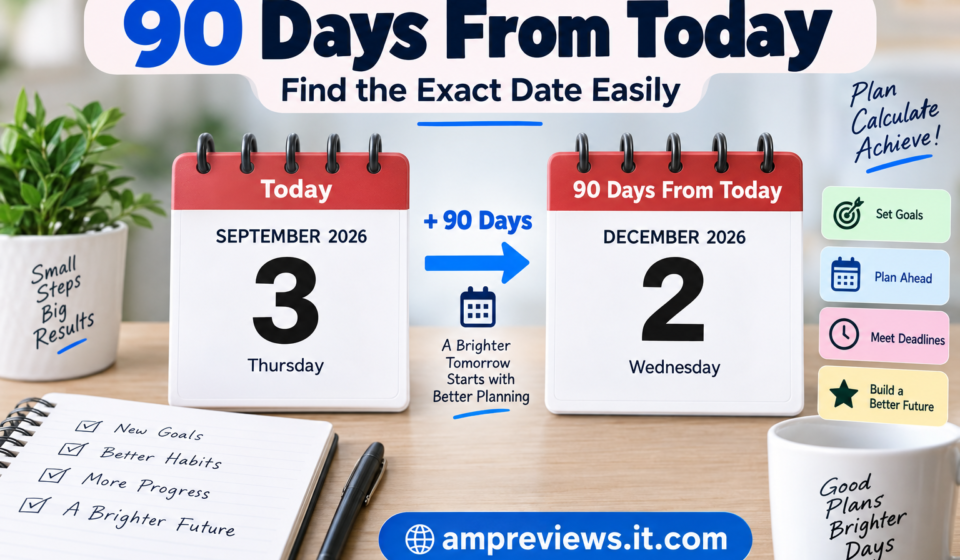
For example, if today is September 3, adding 90 days takes you into December. The exact result depends on the starting date, so the phrase 90 days from today changes whenever the current date changes.
It is also important to distinguish between adding 90 days and adding three calendar months. These are not always the same. A period of three months can contain 89, 90, 91, or 92 days depending on the months involved.
Is 90 Days From Today Easy to Understand?
Yes. The basic idea is straightforward: start with today’s date and move forward by 90 calendar days. However, manual counting can become confusing because months have different numbers of days.
A 90 day calculator makes the process easier. You enter the starting date, choose the number of days, and the calculator provides the resulting date. This is particularly useful when accuracy matters.
When using any date calculator, check whether it counts the starting day as day one or begins counting from the following day. Different tools can use slightly different counting conventions.
Main Features and Applications
Date Calculation
The main purpose of calculating 90 days from today is to identify a future calendar date. This can be useful when you need a clear target rather than an approximate period.
Instead of estimating “about three months from now,” a date calculation gives you a specific day. That makes planning easier and reduces confusion.
90-Day Planning
A 90-day period is often useful for setting short-term goals. Someone might create a three-month learning plan, fitness routine, business target, or personal project schedule.
Breaking a larger objective into a 90-day period can make it feel more manageable. You can set a starting point, establish milestones, and review your progress when the period ends.
Deadlines and Reminders
Knowing the date 90 days from today can also help with deadlines. For example, a project may require a follow-up after 90 days, or a personal reminder may need to be scheduled for a specific future date.
Rather than relying on memory, it is better to put the calculated date into a calendar or reminder app once you have determined it.
Business and Work Planning
Businesses and professionals may use 90-day periods for project reviews, planning cycles, marketing campaigns, or performance goals. A fixed date helps teams understand exactly when a particular period begins or ends.
For work-related deadlines, always check whether the organization uses calendar days, business days, or another specific definition. Ninety calendar days and 90 working days are very different periods.
Why Do People Use 90 Days From Today?
It Makes Future Dates Clear
One of the biggest advantages is clarity. Instead of saying “sometime in three months,” you can identify the exact calendar date.
This is useful when several people need to work around the same deadline or event.
It Helps With Goal Setting
A 90-day period is long enough to work toward a meaningful objective while still being short enough to track regularly. You can divide the period into weekly or monthly milestones and monitor progress along the way.
It Simplifies Planning
Date calculations can be useful for everything from personal schedules to professional projects. Once you know the exact date, you can add it to your calendar and plan backward if necessary.
It Reduces Manual Counting Errors
Counting days across multiple months can lead to mistakes. A reliable days from today calculator can perform the arithmetic quickly, particularly when the starting date is near the end of a month.
Is Calculating 90 Days Safe and Reliable?
There is no safety concern associated with calculating a date itself. The important issue is accuracy. If the date is being used for an important deadline, appointment, contract, payment, travel arrangement, or official requirement, verify the result with the relevant organization or official documentation.
A calculator should also clearly identify the starting date and the resulting date. If two tools give different answers, check their counting methods rather than assuming one is automatically wrong.
For important plans, remember that time zones and local calendar dates can matter when a deadline is tied to a specific location.
Important Tips for Calculating 90 Days
Before relying on a future date, keep a few practical points in mind.
First, confirm the starting date. “Today” changes every day, so a result calculated today will not be the same tomorrow.
Second, understand the difference between 90 days and three months. If someone specifically says “90 days,” use a day-based calculation instead of simply moving the date three months forward.
Third, check whether weekends and public holidays matter. A normal 90-day calculation includes calendar days. If a deadline only counts working days, you need a business-day calculation instead.
Finally, for an important deadline, write down both the starting date and the calculated end date. This makes it easier to verify the calculation later.
Final Thoughts
Finding 90 days from today is a simple way to turn a time period into a specific future date. It can help with personal goals, work projects, reminders, deadlines, and general planning.
Although you can count the days manually, a reliable date calculator is usually the quickest option. Just make sure you understand whether the calculation uses calendar days, business days, and how the starting day is treated. Once those details are clear, a 90-day date becomes easy to calculate and use for practical planning.