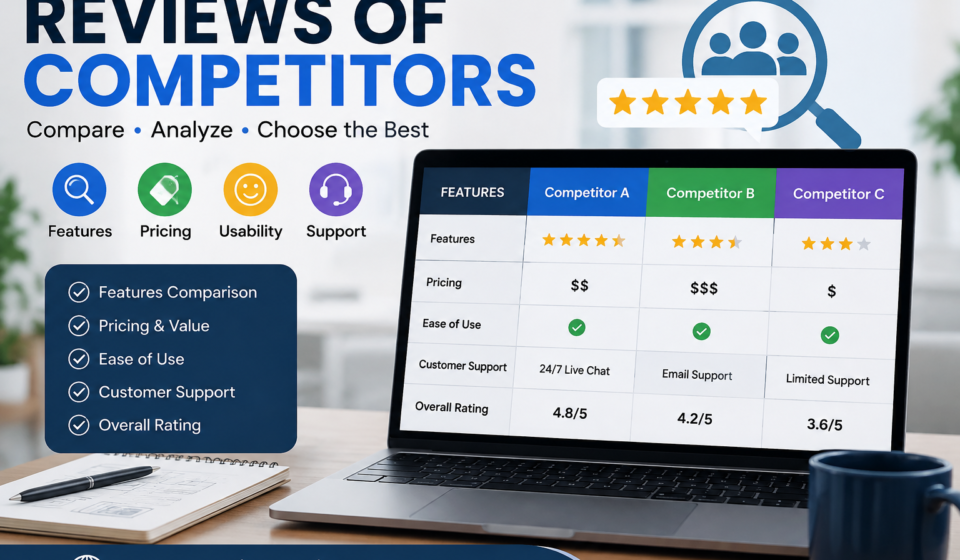

When people are choosing a product, service, software platform, or online business, they rarely look at only one option. Reviews of competitors can help readers understand how similar choices compare in terms of features, pricing, usability, support, reliability, and overall value. A good competitor review does more than say which option is “best.” It explains the differences so people can decide which one fits their own needs.
What Are Reviews of Competitors?
Reviews of competitors are evaluations that compare two or more businesses, products, services, or platforms operating in the same market. Instead of reviewing an option in isolation, this type of content considers what alternatives offer and where each one may have strengths or limitations.
For example, someone choosing project-management software might compare several platforms based on ease of use, collaboration tools, integrations, pricing, and customer support. A competitor review can make that process easier by putting the most important differences into a clear context.
The goal is not necessarily to criticize competitors. A useful comparison should be fair, specific, and based on information that readers can verify.
Are Reviews of Competitors Easy to Understand?
A well-written competitor review should be straightforward, even for someone who has never used the products or services being compared. The writer normally introduces the options first and then examines them according to the same criteria.
The exact comparison method depends on the topic. Software may require attention to operating-system compatibility, integrations, account requirements, and updates. Physical products may need comparisons of specifications, availability, warranties, and maintenance. Services can involve customer support, contracts, delivery methods, and cancellation policies.
Readers should also check whether information is current. Prices, features, plans, availability, and policies can change, so an older review may not provide a complete picture.
Main Areas to Compare
Features and Functionality
Features are usually one of the first things readers want to compare. However, simply counting features can be misleading. A product with more tools is not automatically better if those tools are unnecessary or difficult to use.
A stronger review explains which features are useful for particular situations. For instance, a business may care about team collaboration, while an individual user may prefer simplicity and basic functionality.
Pricing and Overall Value
Price is another important part of competitor comparisons. Reviews should look beyond the headline price and consider what is actually included.
Some services may offer different plans, optional upgrades, usage limits, or additional charges. Readers should therefore compare the complete cost of using an option rather than focusing only on the cheapest advertised plan.
Value also depends on the user’s priorities. Paying more may make sense when an option provides capabilities that are genuinely useful, while a simpler and less expensive alternative may be perfectly suitable for basic needs.
Ease of Use
A product can have impressive capabilities but still be frustrating if its interface is confusing. Competitor reviews should consider how easy it is for a new user to get started.
Important factors can include navigation, setup, documentation, account management, and the learning curve. Where possible, reviews should distinguish between genuinely difficult software and products that simply require a short adjustment period.
Customer Support
Customer support can become particularly important when something goes wrong. Reviews may compare available support channels, such as help centers, email, live assistance, or community resources, when those details are publicly documented.
It is also useful to consider whether support information is easy to find and whether users have access to useful documentation. Support quality can vary over time, so readers should avoid treating one person’s experience as universal.
Compatibility and Availability
Compatibility is easy to overlook during a comparison. A service may work differently depending on the device, operating system, browser, region, or other technical requirements.
Before choosing an option, readers should check the provider’s current requirements. This is especially important for software, subscriptions, online services, and products that depend on other hardware or platforms.
Why Do People Read Competitor Reviews?
To Make Better Decisions
Comparing alternatives gives people a broader view before they spend money or commit to a service. Instead of relying on a single company’s marketing message, readers can consider several options side by side.
This can be especially helpful when the products appear similar but differ in important details.
To Find a Better Fit
There is rarely one perfect choice for everyone. A freelancer, student, small business, and large organization may have completely different requirements.
Reviews of competitors help readers identify which option matches their budget, technical ability, priorities, and expected usage.
To Save Research Time
Doing independent research on multiple websites can take considerable time. A well-organized comparison brings common decision factors together in one place.
Readers can then investigate the options that appear most relevant rather than starting from scratch.
To Understand Strengths and Limitations
Balanced reviews should discuss both positive and negative aspects. This gives readers a more realistic idea of what to expect.
A useful review does not need to declare a universal winner. Sometimes the best conclusion is that one option works better for beginners while another is more suitable for advanced users.
Are Reviews of Competitors Safe and Reliable?
Competitor reviews are generally useful as research material, but readers should not assume that every review is completely objective. Some comparison articles may contain affiliate relationships, sponsorships, promotional content, or opinions based on limited experience.
For greater confidence, compare information from several independent sources and check important details on the official website of the product or service. Pay particular attention to pricing, privacy policies, security information, system requirements, refund conditions, and current features.
Reviews should also separate facts from opinions. Statements such as “this platform includes feature X” can be checked, while “this is the easiest platform” is subjective and depends on the user.
Important Tips When Comparing Competitors
Start by deciding what matters most to you. If price is your priority, focus on total cost. If reliability or security is more important, examine the provider’s official documentation and policies.
Avoid choosing an option simply because it has the longest list of features. Consider whether those features solve an actual problem.
It is also worth checking the date of a review. Technology and online services can change quickly, and information that was accurate several months ago may no longer apply.
Finally, be cautious with extremely positive or negative reviews. One unusual experience may not represent the typical customer experience. Looking for consistent patterns across multiple sources is usually more useful.
Final Thoughts
Reviews of competitors are most valuable when they provide a fair and practical comparison rather than simply promoting one choice. By looking at features, pricing, usability, support, compatibility, and reliability, readers can understand what separates similar options.
The best approach is to use reviews as a starting point, then verify important details through current and trustworthy sources. Instead of asking which competitor is universally the best, ask which option provides the right combination of features, cost, and convenience for your particular needs.