
Finding the factors of a number is an important part of basic mathematics, but doing it manually can become time-consuming when the numbers get larger. A factor calculator makes this process much easier by quickly identifying the numbers that divide a given value without leaving a remainder. Whether you are a student checking homework, a teacher preparing examples, or simply trying to understand number relationships, a factor calculator can be a useful learning tool.
What Is a Factor Calculator?
A factor calculator is a mathematical tool designed to find the factors of a whole number. A factor is a number that divides another number exactly, meaning there is no remainder.
For example, consider the number 24. Its factors include 1, 2, 3, 4, 6, 8, 12, and 24. Each of these numbers can divide 24 evenly.
A factor calculator performs this process automatically. Instead of testing many possible numbers yourself, you enter the number into the calculator, and it identifies the values that divide it evenly. Some calculators can also show factor pairs or the prime factorization of the number.
Is a Factor Calculator Easy to Use?
Yes, most factor calculators are straightforward. The basic process usually involves entering a positive whole number and selecting the calculate option. The tool then checks possible divisors and displays the factors.
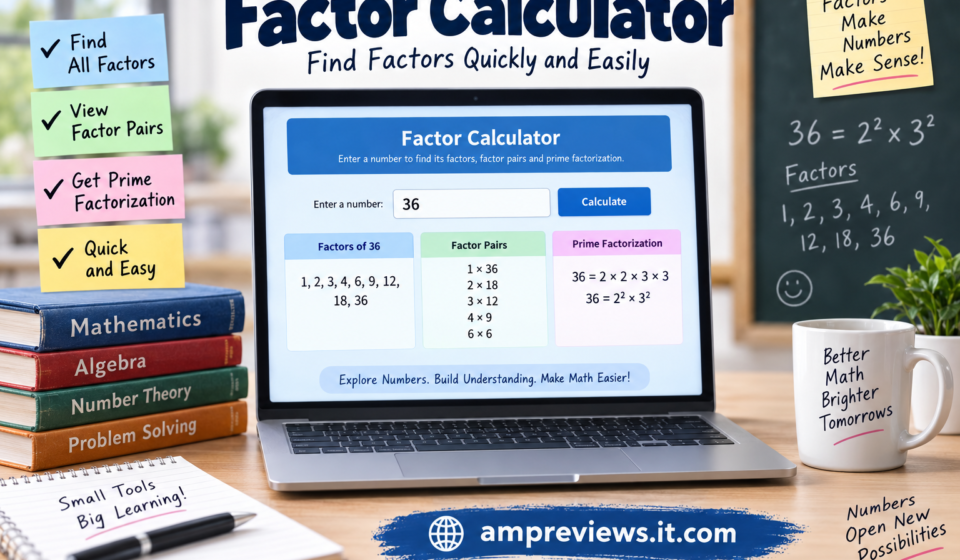
For instance, if you enter 36, the calculator can return factor pairs such as 1 × 36, 2 × 18, 3 × 12, 4 × 9, and 6 × 6.
The main thing to remember is that factors are normally discussed with whole numbers. If you are working with decimals, fractions, or negative numbers, check what the particular calculator supports before relying on its result.
Main Features of a Factor Calculator
Finding All Factors
The most common use is finding all factors of a number. If you enter 48, for example, the calculator can identify the complete set of positive factors rather than requiring you to test each number manually.
This is particularly useful when working with larger values, where checking divisibility one number at a time can take longer.
Factor Pairs
A factor pair consists of two numbers that multiply together to produce the original number. For 30, the pairs include 1 × 30, 2 × 15, 3 × 10, and 5 × 6.
Seeing factor pairs can make multiplication and division relationships easier to understand. It can also help students recognize why a number has a particular set of factors.
Prime Factorization
Some factor calculators go beyond listing ordinary factors and provide the prime factorization of a number. Prime factorization breaks a number down into prime numbers that multiply together to create the original value.
For example:
60 = 2 × 2 × 3 × 5
This can also be written as:
60 = 2² × 3 × 5
Prime factorization is useful in topics such as simplifying fractions, finding the greatest common factor, and finding the least common multiple.
Checking Divisibility
A factor calculator can also help demonstrate divisibility. If a number appears in the factor list, it means that the original number can be divided by it without a remainder.
This provides a quick way to check calculations and understand how different numbers relate to one another.
Why Do People Use a Factor Calculator?
It Saves Time
One of the biggest advantages is speed. Small numbers are easy to factor by hand, but larger numbers require more checking. A calculator can produce the result much faster.
This does not mean manual factoring is unnecessary. Learning the process is still valuable, especially for students. The calculator can simply act as a convenient way to verify the answer.
It Helps With Math Homework
Students often encounter factors when studying multiplication, division, prime numbers, fractions, and number theory. A factor calculator can be useful for checking whether an answer is correct after completing the problem independently.
For learning purposes, it is better to understand why a number is a factor rather than simply copying the calculator’s result.
It Supports Other Calculations
Factors are used in several common mathematical tasks. For example, finding the greatest common factor (GCF) requires comparing the factors of two or more numbers. Similarly, finding the least common multiple (LCM) often involves understanding their factor relationships.
A factor calculator can therefore be a helpful starting point for these calculations.
It Makes Large Numbers Easier to Explore
Large numbers can contain many factors, making manual checking inconvenient. A calculator gives you a quick overview and can help you investigate patterns in numbers without spending excessive time on repetitive division.
Is a Factor Calculator Safe?
From a mathematical perspective, a basic factor calculator is generally a low-risk tool because its purpose is simply to perform calculations. However, the reliability of the result depends on the quality of the tool you use.
If you are using an online calculator, choose a reputable mathematics website and check that the result makes sense. For important academic work, it is also a good idea to verify the answer manually or with another trusted calculation method.
You should also be careful when using unfamiliar websites. Avoid entering unnecessary personal information into a calculator that only needs a number to perform its function.
Important Tips for Using a Factor Calculator
A calculator should support your understanding rather than replace it. Before using one, try to identify some obvious factors yourself. Every positive whole number has 1 and itself as factors, while prime numbers have no other positive factors.
You can also use divisibility rules to make factoring easier. For example, an even number is divisible by 2, while a number whose digits add up to a multiple of 3 is divisible by 3.
After getting an answer, multiply the factor pairs together to confirm that they produce the original number. This simple check can catch mistakes and reinforce your understanding of factors.
Final Thoughts
A factor calculator is a convenient way to find factors, factor pairs, and, with some tools, prime factorization. It can save time with larger numbers and provide a quick way to check mathematical work.
For students, the best approach is to learn the basic principles of factoring first and then use the calculator as a verification and practice tool. When used this way, it becomes more than just an answer generator—it becomes a practical aid for understanding how numbers work.