
A proportion calculator is a useful online tool for solving problems where two ratios are equal. Proportions appear in everyday situations, from adjusting recipes and comparing prices to solving mathematics homework. Instead of working through every calculation manually, a proportion calculator can quickly determine the missing value and help you check your answer.
What Is a Proportion Calculator?
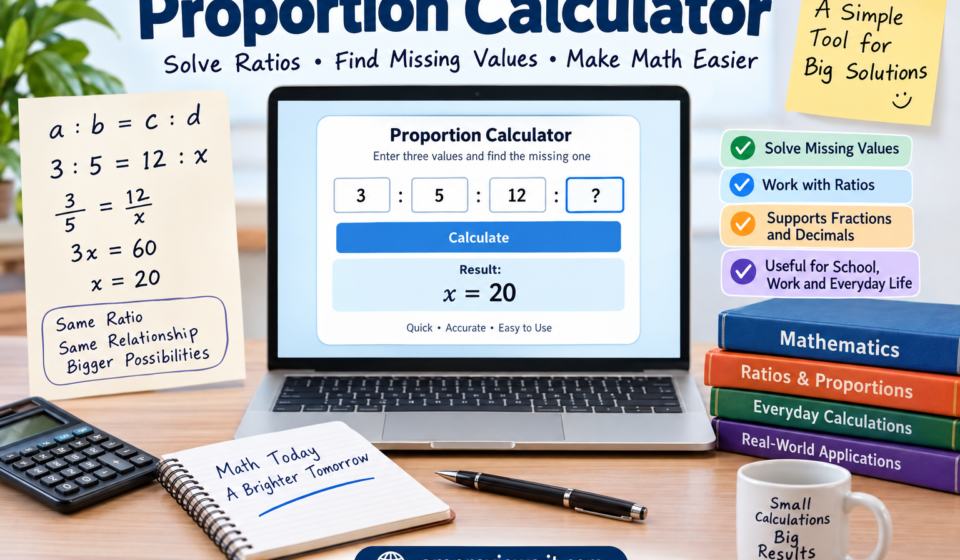
A proportion calculator is a tool designed to solve equations based on proportional relationships. A common proportion looks like:
a : b = c : d
If one of these values is missing, the calculator can determine the unknown number when the other three values are provided.
For example, suppose you need to solve:
3 : 5 = 12 : x
The relationship can be written as:
3/5 = 12/x
Cross-multiplication gives 3x = 60, so x = 20.
A proportion calculator performs this type of calculation automatically. It is particularly helpful when the numbers contain decimals, fractions, or larger values that are more difficult to calculate by hand.
Is a Proportion Calculator Easy to Use?
Yes. Most proportion calculators are designed to be straightforward, even for people who are not confident with mathematics. You generally enter three known values and leave the fourth position for the unknown value.
The calculator then uses the relationship between the ratios to find the missing number. Depending on the tool, you may be able to enter whole numbers, decimals, or fractions.
The main thing to remember is that the values must be arranged correctly. A proportion only works when corresponding quantities are placed in the same order. For instance, if one ratio represents miles to hours, the other ratio should use miles to hours as well.
Main Features and Applications
Solving Missing Values
The most common use of a proportion calculator is finding an unknown value. If you know three parts of a proportion, the calculator can determine the fourth.
For example, if 4 notebooks cost $12, you can use a proportion to estimate the price of 10 notebooks:
4/12 = 10/x
The calculator can solve for x = 30, assuming the price remains proportional.
This makes the tool useful for classroom exercises as well as practical calculations.
Working With Ratios
Ratios compare two quantities, such as 2:3 or 5:8. A proportion shows that two ratios have the same relationship.
A proportion calculator can help users compare ratios and determine whether values form a proportional relationship. This is useful when checking homework, comparing measurements, or working with scale drawings.
Fractions and Decimals
Proportion problems do not always contain simple whole numbers. Fractions and decimals can make manual calculations more complicated.
A calculator can handle these values and return a result without requiring the user to convert everything into another format first. However, users should still understand what the numbers represent before entering them.
Real-World Scaling
Proportions are commonly used when something needs to be increased or decreased while maintaining the same relationship.
For example, if a recipe serves four people but you want to prepare enough for eight, proportions can help you adjust the ingredients. The same idea can apply to maps, models, construction measurements, recipes, and other scaling tasks.
Checking Manual Calculations
A proportion calculator does not have to replace learning. It can also work as a checking tool.
You can solve a problem yourself and then enter the same values into the calculator. If the answers differ, you can go back and check your setup, multiplication, division, or placement of the values.
Why Do People Use a Proportion Calculator?
It Saves Time
Simple proportions can be solved quickly by hand, but calculations involving awkward numbers may take longer. A calculator can provide the result almost immediately, allowing users to focus on understanding the problem rather than repeatedly performing arithmetic.
It Helps With Learning
For students, using a calculator after attempting a problem can be a useful way to identify mistakes. Seeing the correct result can encourage them to review how the proportion was arranged and understand where their calculation went wrong.
It is best used as a learning aid rather than simply entering every homework problem without understanding the process.
It Is Useful Beyond School
Proportions are not limited to mathematics classes. They can appear when comparing unit prices, adjusting quantities, reading maps, converting measurements, or scaling designs.
Someone working on a small DIY project, for example, may need to maintain the same measurement ratio when changing the size of a design.
It Reduces Basic Arithmetic Errors
Manual calculations can lead to mistakes, especially when several steps are involved. A proportion calculator can reduce errors in the arithmetic portion of the problem, although the user still needs to enter the correct values and interpret the result properly.
Is a Proportion Calculator Safe?
A basic proportion calculator is generally a low-risk mathematical tool because it does not require sensitive information to solve an ordinary calculation. However, the quality and privacy practices of online calculators can differ.
When using an unfamiliar website, avoid entering personal, financial, or other private information into a calculator that does not need it. It is also worth checking that the website clearly explains what the tool does and presents the calculation in a way that you can verify.
For important work, do not rely blindly on a single result. Understanding the formula and checking whether the answer makes sense are both good practices.
Important Tips for Using a Proportion Calculator
Before entering numbers, identify exactly what each value represents. Make sure corresponding quantities are kept in the same order.
For example, if the first ratio is distance/time, the second ratio should also be distance/time, not time/distance.
It is also helpful to estimate the answer before calculating. If you expect the missing value to be around 20 but the calculator produces 2,000, that difference is a reason to check the setup.
Finally, remember that a calculator gives an answer based on the information provided. It cannot determine whether the original numbers or assumptions are appropriate. Correct input is just as important as correct calculation.
Final Thoughts
A proportion calculator is a convenient way to solve missing-value problems involving equal ratios. It can make calculations faster, help students check their work, and simplify practical tasks involving scaling and comparisons.
The best approach is to understand the basic idea behind proportions and then use the calculator as a helpful assistant. Once you know how ratios correspond to each other, even more complicated proportion problems become much easier to handle.