
Introduction
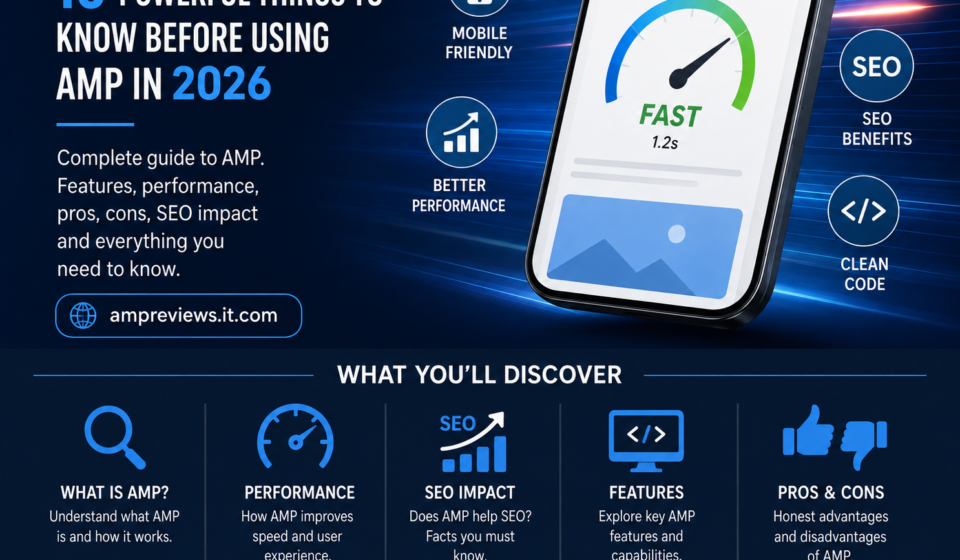
AMP reviews have become useful for people who want to understand how Accelerated Mobile Pages perform in real-world browsing. With most users accessing websites through smartphones, page speed, mobile usability, and smooth navigation can strongly influence the overall experience. AMP, short for Accelerated Mobile Pages, was designed around the idea of making web pages load quickly and remain easy to use on mobile devices. However, simply seeing that a website uses AMP doesn’t automatically mean it provides a better experience. A meaningful AMP review should look at speed, usability, content presentation, technical implementation, and the needs of the audience.
What Is AMP?
AMP is an open web technology framework created to help publishers build fast-loading mobile pages. It uses a streamlined approach to HTML, CSS, and JavaScript, along with caching and performance-focused rules. The goal is straightforward: reduce unnecessary loading time and create pages that work smoothly on smaller screens.
When implemented correctly, AMP can make content feel more immediate. Readers can open an article, scan headings, view images, and interact with important elements without waiting for a large number of resources to load. This can be particularly helpful for news websites, blogs, publishers, and content-heavy platforms where mobile visitors make up a large portion of the audience.
Why AMP Reviews Matter
A good AMP review does more than check whether a page loads quickly. Website owners should understand why a page feels fast and whether that speed actually improves the visitor’s experience. A technically fast page can still be frustrating if navigation is confusing, advertisements overwhelm the content, or important features are missing.
Reviews can also help identify problems that may not be obvious during everyday browsing. Broken layouts, oversized images, poor mobile typography, unnecessary scripts, and slow third-party resources can all affect performance. Reviewing these areas provides a clearer picture of the website’s actual quality.
Key Areas to Examine in AMP Reviews
Mobile Speed
Speed is one of the most important areas to examine. A mobile visitor usually expects content to appear quickly, especially when browsing on a slower connection. AMP pages are designed to limit heavy resources and prioritize efficient delivery.
However, speed should be measured rather than assumed. An AMP implementation can still become inefficient if the surrounding website contains poorly optimized images, excessive tracking resources, or complicated external components. Therefore, a proper review should consider the complete page experience.
User Experience
Performance is only one part of a successful website. Visitors also need readable text, logical navigation, accessible buttons, and properly displayed media.
During an AMP review, it’s useful to check how the page behaves across different screen sizes. Text should remain comfortable to read without constant zooming. Images should fit naturally within the layout, while menus and links should be easy to recognize and use.
Content Quality
Technical optimization cannot compensate for weak content. A fast page with outdated, repetitive, or unhelpful information may still provide little value to readers.
A strong review should therefore consider whether the content answers the visitor’s question clearly. Headings should organize the subject logically, paragraphs should remain focused, and important information should be easy to find. Original insights and trustworthy information can make a page much more useful.
AMP and SEO Considerations
AMP has often been discussed alongside search engine optimization because page experience and mobile performance are important parts of modern web publishing. However, website owners shouldn’t treat AMP as an automatic ranking shortcut.
Search performance depends on many factors, including useful content, technical accessibility, relevance, mobile usability, internal linking, and overall page experience. An AMP version can support a strong technical foundation, but it does not replace good SEO practices.
This is why AMP reviews should focus on the complete website rather than one technical feature. A balanced assessment can reveal whether AMP is genuinely helping the site or whether the same performance goals could be achieved through other modern web-development techniques.
Common AMP Problems
AMP implementations can sometimes create challenges. One issue is feature limitations. Some websites rely heavily on interactive elements, complex forms, personalized experiences, or advanced JavaScript functionality. Rebuilding these features within AMP’s restrictions may require additional development work.
Another concern is maintaining multiple page versions. If a website has both standard and AMP pages, publishers must ensure that content, metadata, canonical relationships, and tracking remain properly configured. Poor implementation can create confusion for both users and search engines.
Regular technical reviews are therefore important. Website owners should check that pages remain functional after design changes, plugin updates, or content-management-system modifications.
How to Conduct a Useful AMP Review
Start by visiting several representative pages on mobile devices. Don’t review only the homepage. Check articles, category pages, landing pages, and other important content types.
Next, evaluate loading behavior and visual stability. Look for elements that jump while loading, images that appear too late, or interactive components that respond slowly. Then review the content itself. Ask whether the information is clear, original, accurate, and easy to navigate.
Finally, compare the AMP experience with the standard version when both exist. This comparison can reveal whether AMP is actually improving performance and usability or simply adding another version that requires maintenance.
Final Thoughts
AMP reviews provide a practical way to evaluate mobile website performance beyond simple speed claims. The strongest reviews consider technical efficiency, user experience, content quality, accessibility, and SEO together. AMP can be useful for publishers and websites that prioritize fast mobile content, but its value depends heavily on implementation.
For website owners, the best approach is to measure real performance, listen to user behavior, and regularly inspect important pages. Whether a site uses AMP or another performance strategy, the ultimate goal remains the same: deliver useful content quickly, clearly, and reliably to every visitor.