
Introduction
The ukulele history is a fascinating story of migration, music, craftsmanship, and cultural exchange. Although the ukulele is strongly associated with Hawaii today, its roots can be traced to Portuguese immigrants who brought small stringed instruments to the Hawaiian Islands in the late 19th century. Over time, local makers and musicians transformed those early instruments into something distinctly Hawaiian. From traditional island music to modern pop, the ukulele has continued to evolve while keeping its cheerful sound and approachable character.
What Is Ukulele History?
Ukulele history explains how the instrument developed from its European influences into the four-stringed instrument recognized around the world today. The ukulele belongs to the family of plucked string instruments and is commonly played by strumming or picking its strings with the fingers.
Its development is closely connected with Hawaii. Portuguese immigrants arrived in the islands during the 1870s, particularly from Madeira and the Azores. They brought small instruments such as the machete, braguinha, and rajão. These instruments influenced Hawaiian craftsmen, who adapted their designs and eventually created instruments that became known as ukuleles.
The name “ukulele” is commonly translated as “jumping flea,” although the exact origin and interpretation of the name have been debated. Regardless of the translation, the instrument quickly became part of Hawaiian musical culture.
Is Ukulele History Easy to Understand?
The basic story is fairly easy to follow, although the instrument’s development involved several cultures and different types of stringed instruments. Rather than appearing suddenly in its modern form, the ukulele developed gradually through experimentation and local craftsmanship.
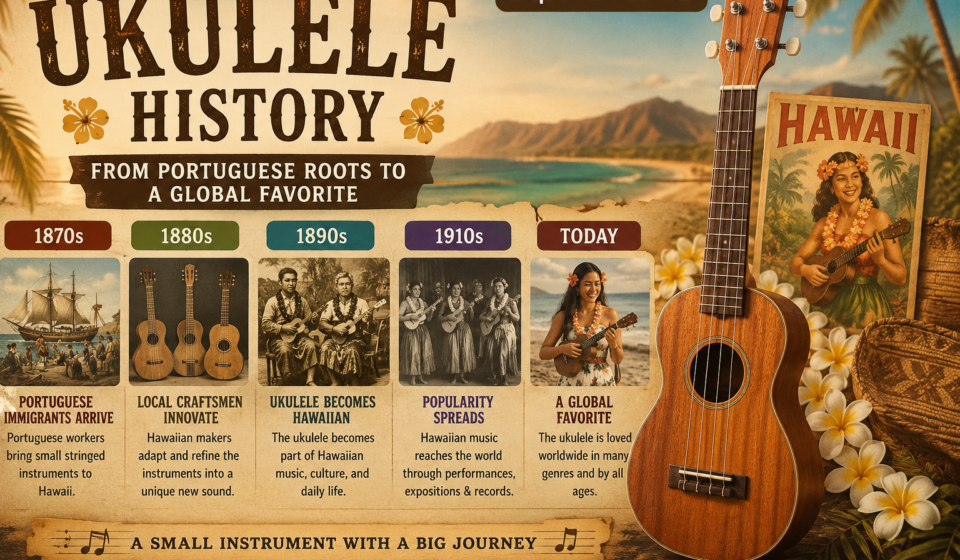
For beginners interested in the subject, it helps to think of the history in stages: Portuguese instruments arrived in Hawaii, local builders modified them, Hawaiian musicians adopted the new instrument, and its popularity eventually spread beyond the islands.
The modern ukulele is also available in several sizes. Soprano, concert, tenor, and baritone ukuleles have different body sizes and ranges, but they all share the basic idea of a compact string instrument.
Important Stages in Ukulele History
Portuguese Instruments Arrive in Hawaii
A major turning point came in the 1870s when Portuguese workers migrated to Hawaii. Many came to work in agriculture, particularly on sugar plantations. Along with their traditions and culture, they brought small, guitar-like instruments.
These instruments were lightweight and relatively easy to carry. Their lively sound attracted attention among Hawaiian communities, creating an important foundation for the future development of the ukulele.
Hawaiian Makers Develop the Instrument
Hawaiian craftsmen played a central role in turning Portuguese influences into a new instrument. Makers such as Manuel Nunes, José do Espírito Santo, and Augusto Dias are historically associated with early ukulele construction.
They experimented with instrument shapes, materials, and construction techniques. The resulting instrument became smaller and distinct from the Portuguese instruments that had influenced it.
This local craftsmanship was important because it helped establish the ukulele as a Hawaiian instrument rather than simply a version of an imported European design.
The Ukulele Becomes Part of Hawaiian Culture
As musicians began playing the instrument, the ukulele became increasingly connected with Hawaiian music and social life. Its bright tone worked well with singing and traditional musical performances.
The instrument also benefited from royal interest. Hawaiian King Kalākaua was a supporter of music and the arts and helped promote the ukulele within Hawaiian cultural life. His association with the instrument contributed to its growing visibility.
The Instrument Reaches Mainland America
The ukulele gained major exposure outside Hawaii during the early 20th century. Hawaiian music became popular in the United States, and the instrument appeared in performances and exhibitions.
The Panama-Pacific International Exposition in San Francisco in 1915 helped introduce Hawaiian culture and music to a wider American audience. The ukulele became increasingly familiar to mainland audiences and eventually entered American popular entertainment.
Ukulele Popularity Expands
During the 20th century, the ukulele moved through different periods of popularity. It appeared in vaudeville, radio, recordings, movies, and popular music.
Manufacturers also began producing instruments for larger audiences. As production increased, ukuleles became available in different price ranges, making them accessible to students, hobbyists, and professional musicians.
Why Do People Use the Ukulele?
It Is Compact and Portable
One reason for the ukulele’s lasting appeal is its convenient size. Compared with many guitars, a ukulele is small and lightweight, making it easy to carry to lessons, gatherings, rehearsals, or performances.
Its compact design also makes it a practical choice for people who want to learn a string instrument without handling a full-sized guitar.
It Has a Distinctive Sound
The ukulele produces a bright, gentle sound that works particularly well for singing and simple accompaniment. Its tone has become strongly associated with Hawaiian music, although musicians now use it across many genres.
Modern players can hear ukulele performances in folk, pop, jazz, acoustic music, and other styles.
It Is Popular With Beginners
The ukulele is often chosen by beginners because of its manageable size and relatively simple chord shapes. Learning a few basic chords can allow a new player to accompany songs quite quickly.
That does not mean the instrument has limited potential. Experienced players use advanced fingerpicking, melody playing, rhythmic techniques, and complex arrangements to create sophisticated performances.
Is Ukulele History Reliable?
When learning about ukulele history, it is important to recognize that some details have competing interpretations. The broad connection between Portuguese immigrant instruments and the development of the Hawaiian ukulele is well established, but specific questions about the name and earliest examples can be discussed differently by historians.
Readers should look for information from museums, cultural institutions, historical archives, and reputable music-history sources. This is especially useful when researching the origins of particular instruments or claims about individual makers.
Important Tips When Learning About Ukulele History
A good way to study the subject is to avoid viewing the ukulele as an instrument with a single origin. Its story reflects cultural exchange between Portuguese immigrants and Hawaiian communities.
It is also useful to distinguish between the instruments that influenced the ukulele and the modern ukulele itself. Portuguese instruments provided important inspiration, but Hawaiian makers and musicians played a significant role in shaping the instrument’s identity.
If you plan to learn the ukulele yourself, understanding this background can make the instrument more meaningful. Try listening to traditional Hawaiian recordings alongside modern ukulele performances to appreciate how its role has changed over time.
Final Thoughts
The story of ukulele history is much bigger than the instrument’s small size suggests. Portuguese musical traditions, Hawaiian craftsmanship, royal support, American popular culture, and modern musicians all contributed to its journey.
Today, the ukulele remains popular because it combines portability, a distinctive sound, and an approachable learning experience. Whether you are researching its origins or thinking about picking one up for the first time, understanding its history gives you a better appreciation of the instrument and the cultures that helped shape it.